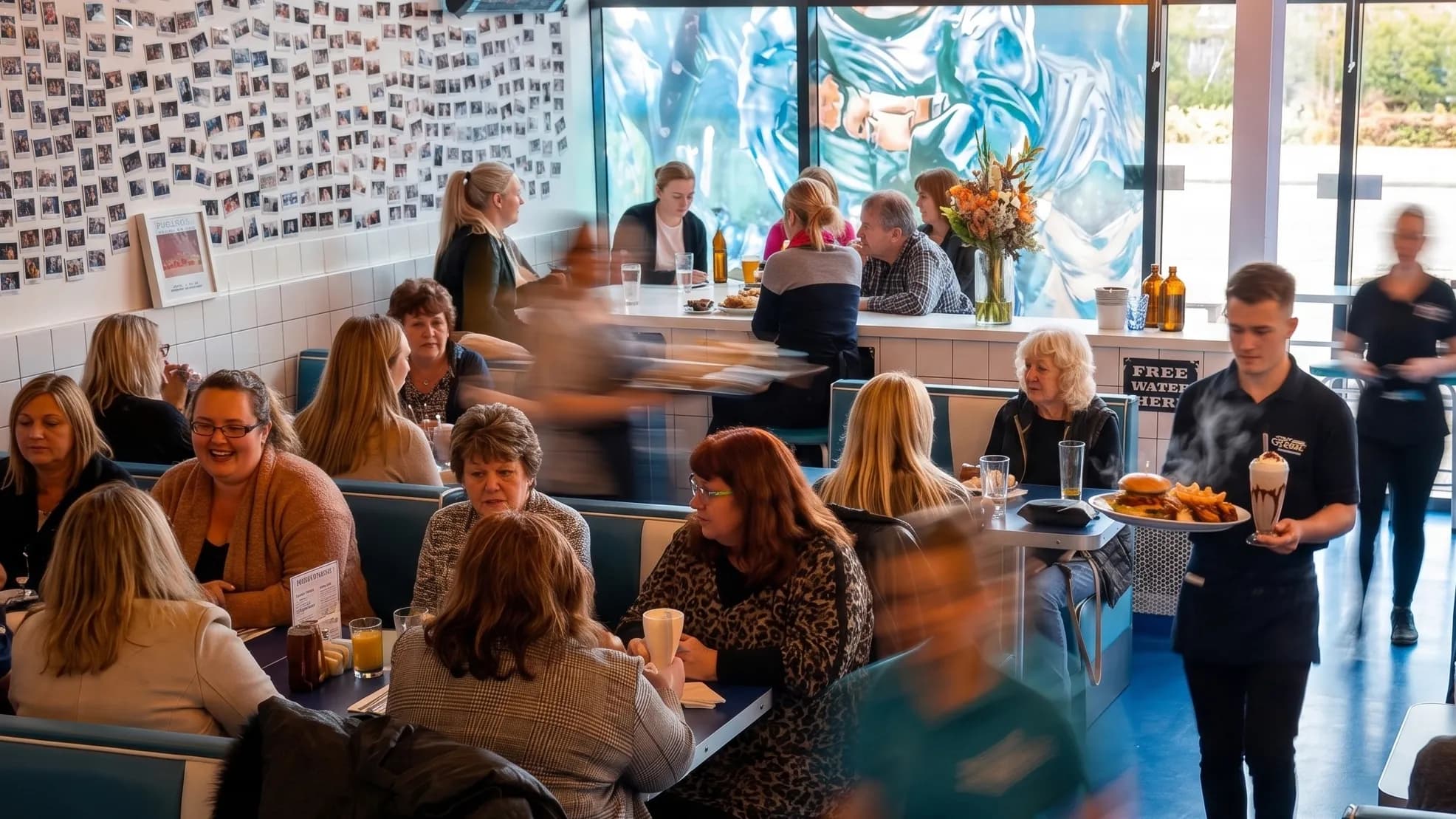
A growth funnel built on sharp unit economics, driving 20x online ordering growth in two years.
CategorySales Funnel & Customer Loyalty
EngagementProject · 2020-2022
Steps08
01 · The situation
Growth that pays for itself.
In 2020, Fush wanted to grow without growth eating its own margin. For a full table-service restaurant, more customers usually means more staff and more cost. We built a funnel that brought in new customers profitably, then pushed that demand online so the kitchen could absorb it without the wage bill climbing to match.
Online ordering growth, 2020 to 2022
20x
Marginal profit per new customer
$18
Return on ad spend
8x
Margin per customer, vs 10% typical
40%
02 · What we built
The funnel, end to end.
The funnel ran on Meta ads into a connected stack of HubSpot, Zapier, and Coupon Carrier, with a custom POS integration so a scanned QR code tied straight to a customer's account in store. A prospect saw an ad, signed up, and got a unique two-for-one offer by email, led with the secondary menu, fish and chips and fried chicken, so it pulled people in without discounting the hero dishes.
New customers only
Meta ad
Coupon Carrier email offer
2-for-1
POS scan in store
QR redeem
03 · The clever part
Paid once, came back twice more.
The clever part was what happened after they redeemed. We kept the email and retargeted them with automated follow-ups: a second offer, then a third. About 35 percent reconverted at each tier, so a single acquired customer was brought back at least twice more. Those return visits cost almost nothing to drive, no ad spend, just the overhead of the email and marketing software. So while the first visit cleared about $18, each repeat visit cleared closer to $23, because there was no acquisition cost left to carry.
Reconverted at each offer tier
35%
Further visits per acquired customer
2
Ad spend on return visits
~$0
04 · Demand moved online
Twentyfold in two years.
It all worked because we advertised to new customers only, so every ad dollar bought incremental revenue instead of subsidising regulars. With wages and overheads already covered by the existing business, those extra customers did not need extra staff, right up to a critical mass of about a 20 percent lift in sales. To hold that advantage as volume grew, we drove orders online, so the kitchen could absorb the demand while the floor stayed free for returning and local diners. Online ordering sales grew twentyfold between 2020 and 2022.
Online ordering salesIndexed · 2020 to 2022
05 · Why three visits
The whole funnel buys the third visit.
There was a reason we engineered for exactly three visits. Restaurant loyalty does not behave like e-commerce.
As restaurant operator John Taffer describes it:
·A flawless first visit gives a customer only about a 30 percent chance of returning.
·A flawless second lifts it to around 40 percent.
·A flawless third visit takes the odds of them coming back to roughly 75 percent.
Three good visits turn a one-off into a regular, so the whole funnel exists to buy that third visit.
After it, the customer keeps coming back on their own, at no marketing cost at all.
Likelihood of returningThe John Taffer effect
06 · The economics
Per new customer.
·Leads came in under $2.
·35 percent converted, so a new customer cost about $5.50 to acquire.
·Average spend after discount was $43.50.
The food needs honest accounting: the two-for-one meant a meal worth $20 to $25 left the kitchen free, and that food still costs about 30 percent to make.
·So the real food cost is closer to $20, near 45 percent of the discounted bill.
·Even after that, each new customer leaves about $18 of marginal profit.
Marginal basis: wages and overheads sit still because the funnel only adds incremental customers the existing base already covers.
07 · Three ways to count it
Margin is a point of view.
The same new customer can look like a loss, a thin win, or a strong one, depending on what you charge against the visit.
·Spread full wages and overheads across every incremental diner and the deal looks like about a dollar lost.
·Take the usual 10 percent on a $43.50 bill and you get $4.35, a normal restaurant margin.
·Count only what truly moves with each extra seat, food at its honest cost after the two-for-one, plus acquisition, and about $18 is left. That is the marginal reality: roughly four times a standard margin.
For a restaurant scaling on top of an existing base, that last view is the honest one. Fixed costs are already paid. Growth only has to cover its own variable bill.
Naive full-cost view, charging each new customer full wages and overheads
-$1
A normal restaurant at the standard 10 percent margin
$4.35
The marginal reality, about four times a standard margin
$18
08 · And then they came back
Around $29 a customer, before loyalty.
Each repeat visit was driven by email to a customer we had already paid to acquire, so it carried no ad cost, only the small overhead of the email and marketing software. That makes every return visit a little more profitable than the first. Blended across three visits at a 35 percent step, an acquired customer is worth around $29 of marginal profit, and that is before the long-term loyalty from the third-visit effect compounds on top.
Reconversion ran at about 35 percent per tier, with no acquisition cost on the return visits.
First visit, after the acquisition cost
$18
Each repeat visit, no acquisition cost
~$23
Expected per acquired customer across the funnel, before long-term loyalty
~$29
Results
From a standing start to a twentyfold increase in online ordering, with every new customer landing at four times a normal margin and engineered to become a regular by their third visit.
In their words
“I've had the privilege of working with Tuned for several years, and I can confidently say they are among the most professional, hardworking, and reliable partners I've ever collaborated with. Tuned has an incredible eye for detail and a creative mindset that consistently elevates the work we do together. What truly sets them apart is their understanding of business. As a business owner, I appreciate that they always take my perspective into consideration, aligning their work with my goals and vision. Their ability to blend creativity with practical business insight is a rare combination that has been invaluable to me. I would wholeheartedly recommend Tuned to anyone looking for a talented and dependable team who will go the extra mile to deliver exceptional results.”